Berberine vs Ozempic: What It Actually Does to Metabolism
If you've spent any time on social media in the last two years, you've probably seen berberine called "nature's Ozempic." It's a catchy line. It's also not quite accurate, and the gap between the claim and the actual research matters if you're deciding what to put in your body.
Berberine is a plant compound with a real, decades-long research record behind it, mostly in the context of blood sugar and cholesterol management. Semaglutide (the active ingredient in Ozempic and Wegovy) is a synthetic hormone analog delivered by injection, approved by the FDA for type 2 diabetes and, at a higher dose, for chronic weight management. They are not interchangeable, and they don't produce interchangeable results. This article walks through what berberine actually does in the body, what the human research shows, where it overlaps with GLP-1 biology, and where the comparison to Ozempic breaks down.
Quick Answer: Berberine is a plant alkaloid that activates an enzyme called AMPK, which helps cells use glucose more efficiently and modestly improves insulin sensitivity, cholesterol, and gut GLP-1 signaling. Human trials show real but small effects on weight (roughly a pound or two on average) and meaningful effects on blood sugar and lipids. It is not equivalent to semaglutide, which triggers double-digit percentage weight loss in clinical trials through a much stronger, receptor-targeted mechanism.
Key Takeaways
Berberine's primary mechanism is activation of AMPK, a cellular energy sensor, which improves how muscle and liver cells use glucose, an effect researchers have compared to metformin in laboratory studies.
Berberine can also increase the body's own gut GLP-1 secretion by stimulating intestinal L-cells, a mechanism confirmed in both animal and in vitro research, but this is the body producing more of its own hormone, not a synthetic hormone being introduced.
Meta-analyses of randomized controlled trials confirm berberine produces statistically significant reductions in body weight, BMI, waist circumference, and inflammatory markers, though the average magnitude is modest compared to headline social media claims.
Semaglutide produces substantially larger results: participants in major trials lost an average of 10 to 15 percent of body weight over a year, with the STEP 1 trial specifically recording 14.85 percent average loss at 68 weeks.
Berberine is not FDA-reviewed for safety or effectiveness the way a prescription drug is, and it carries a long list of potential medication interactions that make medical guidance important before starting it.
What Is Berberine, and Why Do People Call It "Nature's Ozempic"?
Berberine is a bitter-tasting yellow alkaloid found in several plants, including barberry, goldenseal, and Coptis chinensis, a root long used in traditional Chinese medicine. It has been studied in the context of type 2 diabetes and metabolic syndrome for decades, well before "nature's Ozempic" became a trending phrase.
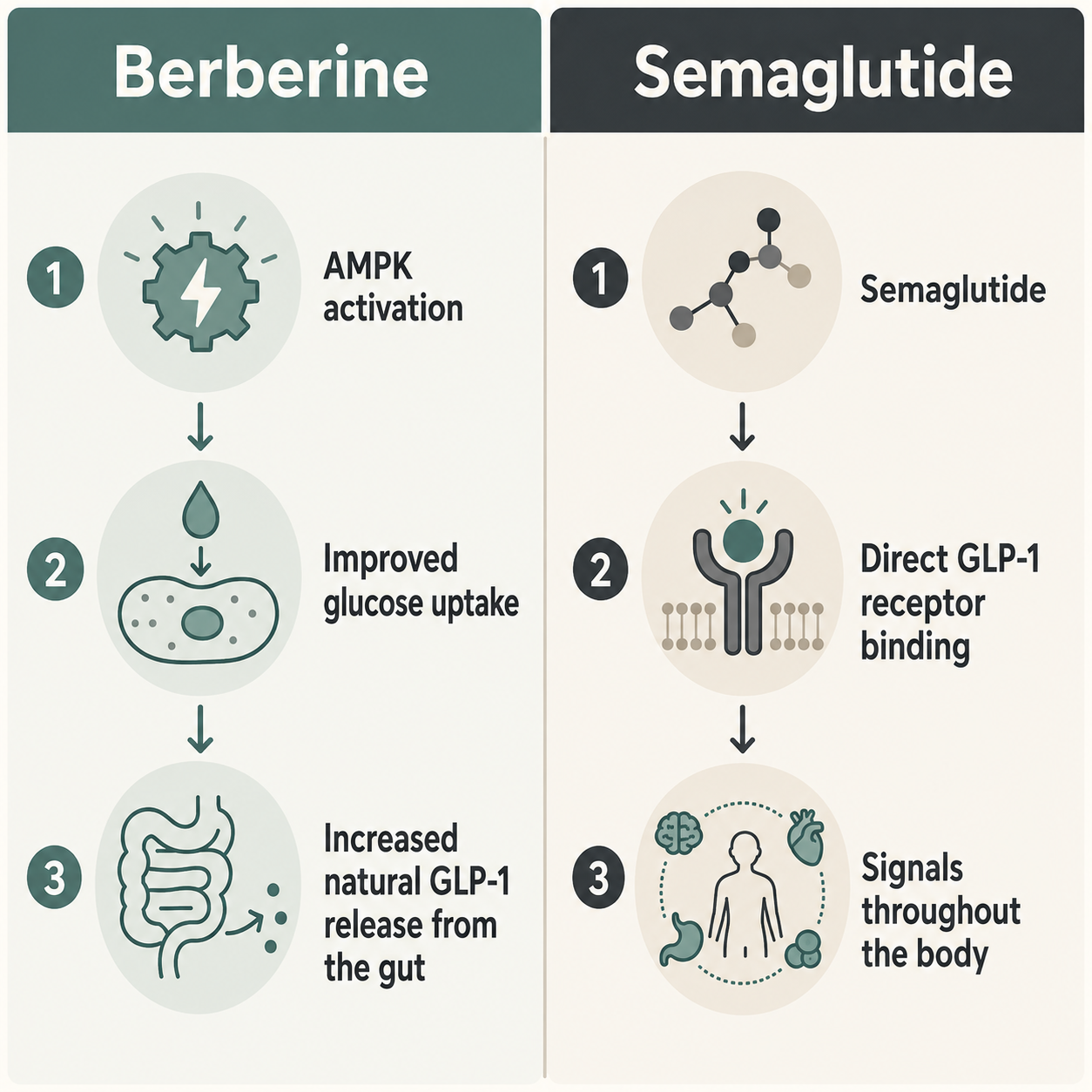
The nickname took off because berberine and semaglutide both eventually intersect with the GLP-1 pathway, the same signaling system involved in appetite and blood sugar regulation. But intersecting with a pathway and directly triggering it in the same way are two very different things. Semaglutide is a lab-synthesized molecule engineered to bind directly and powerfully to GLP-1 receptors throughout the body. Berberine works upstream of that, nudging the body's own metabolic machinery and gut hormone output through a much gentler, multi-pathway mechanism.
How Does Berberine Actually Work in the Body?
Berberine's best-documented mechanism is activation of AMP-activated protein kinase, or AMPK, sometimes described as the cell's metabolic "master switch." When AMPK is activated, cells shift toward burning available fuel more efficiently rather than storing it. Laboratory studies have found that berberine increases glucose uptake in liver and muscle cells in a way researchers have directly compared to metformin, a widely used prescription medication for blood sugar management, though berberine is not metformin and the comparison is limited to this specific cellular mechanism.
Beyond AMPK, research describes berberine acting through several additional pathways that touch glucose transport, lipid metabolism, and gene expression tied to fat storage. It is genuinely a multi-target compound, which is part of why researchers have stayed interested in it for so long.
More recent research has also looked at berberine's effect on the gut itself. Studies show berberine can stimulate intestinal L-cells to release more of the body's own GLP-1, and can shift gut bacteria populations in ways associated with improved short-chain fatty acid production and satiety signaling. This is a meaningfully different mechanism than semaglutide's: berberine appears to encourage the body to produce and use more of its own signaling hormone, while semaglutide is an external, long-acting version of that hormone delivered directly.
What Does the Research Actually Show About Berberine and Weight Loss?
This is where the "nature's Ozempic" framing runs into trouble. Human clinical trials on berberine are real and reasonably numerous, but the outcomes are modest.
Systematic reviews and meta-analyses of randomized controlled trials have found that berberine produces statistically significant, but small, reductions in body weight, BMI, waist circumference, and C-reactive protein compared to placebo. Blood sugar and cholesterol markers tend to show more consistent improvement across studies than the scale number does. Dose and duration matter too: research suggests the more noticeable effects on weight tend to show up in people taking higher doses (generally above 1 gram per day) for longer than eight weeks, with lower doses or shorter trials often showing little difference from placebo.
In short, the honest read on the human data is that berberine is a real, mild metabolic support tool, particularly for blood sugar and lipid markers, not a weight-loss drug substitute.
How Does Berberine's Effect Compare to Semaglutide (Ozempic/Wegovy)?
The difference in magnitude between berberine and semaglutide is not subtle. In the pivotal STEP 1 trial, participants using semaglutide 2.4 mg weekly lost an average of 14.85 percent of body weight over 68 weeks, compared to 2.41 percent in the placebo group. More broadly, research summaries note that GLP-1 medications have produced average weight loss of 10 to 15 percent of body weight over a year in study populations, with the most effective formulations exceeding 20 percent in some participants.
Berberine's pooled trial results, by contrast, land in a fraction-of-a-kilogram to low-single-digit-pound range on average. It simply does not work through the same forceful, receptor-targeted mechanism, and it is not regulated, dosed, or monitored the way a prescription drug is. Anyone who tells you berberine "does the same thing" as semaglutide is not describing the research accurately.
What berberine does offer is a different risk and delivery profile: it's taken orally rather than injected, it does not require a prescription, and its side effect and interaction profile, while real and worth taking seriously, is generally less intensive than what's reported with GLP-1 medications. Semaglutide's own clinical trial data shows gastrointestinal side effects, including nausea in roughly 2 to 20 percent of users and diarrhea in up to 13 percent, depending on the study population and dose.

What Are the Risks and Limitations of Berberine?
Berberine is generally well tolerated at standard doses, but it is not risk-free, and it is not without meaningful limitations.
The most common side effects are gastrointestinal: nausea, gas, diarrhea, constipation, and vomiting are all reported, particularly at higher doses. More importantly, berberine has a long list of potential drug interactions, including anti-clotting medications, sedatives, and diabetes drugs such as metformin, because it affects the same liver enzyme pathways many prescription drugs rely on. Combining berberine with a glucose-lowering medication without medical supervision can increase the risk of blood sugar dropping too low.
Berberine also has notably poor natural absorption. Only a small fraction of an oral dose, roughly 5 percent, reaches general circulation, which is part of why researchers have experimented with different delivery formulations to improve bioavailability. And like all dietary supplements sold in the United States, berberine products are not reviewed by the FDA for safety or effectiveness before they reach the market the way a prescription drug is.
None of this makes berberine a bad option. It makes it a supplement that deserves the same respect you'd give any compound that touches blood sugar and hormone signaling: a conversation with your own healthcare provider before you start, particularly if you take other medications, are pregnant or breastfeeding, or have an existing liver or blood sugar condition.
Where Does a Natural, Non-Prescription Approach Like GLP THREE Fit In?
GLP THREE is a different formula from berberine, and it's worth being clear about that distinction rather than blurring it. GLP THREE is a natural liquid dropper supplement built around a patented MBC-267 peptide complex, along with Panax Ginseng Extract, Saffron Extract, and Humulus Lupulus (Hops) Extract. It does not contain berberine, and it is not a synthetic hormone or a prescription medication. Like berberine, it's formulated to support the body's own GLP-1 pathway, appetite signaling, blood sugar levels already in a normal range, fat metabolism, and lean muscle maintenance as part of an active lifestyle, without needles and without a prescription.
If you're exploring natural, non-injectable options because a prescription GLP-1 medication isn't the right fit for your situation, or you simply want to understand what's on the shelf before you commit to anything, it's reasonable to want more than a single ingredient's research to lean on. GLP THREE includes a free consultation and a computerized Body Composition Analysis with Dr. Chris Colgin, DC, a licensed chiropractic physician practicing since 1996, as part of every purchase, so you have a real conversation about your own numbers rather than guessing. The formula itself was developed by Dr. Dan Gubler, a Caltech-trained PhD organic chemist.
Frequently Asked Questions
Is berberine actually as effective as Ozempic? No. Clinical trial data shows semaglutide produces double-digit percentage weight loss on average, while berberine's effects on weight are real but modest, typically a small fraction of that. Their effects on blood sugar and cholesterol are more comparable in direction, though still generally smaller with berberine.
Can I take berberine instead of Ozempic without talking to my doctor? This isn't a decision to make without medical guidance, especially if you currently take a prescription for diabetes, blood pressure, or blood clotting. Berberine can interact with several common medications, and switching off a prescribed treatment on your own carries real risk.
Does berberine raise the body's natural GLP-1 levels? Some research suggests it can modestly increase the body's own gut GLP-1 secretion through effects on intestinal cells and gut bacteria. This is different from semaglutide, which introduces a synthetic, receptor-binding version of the hormone directly.
How long does it take to see results from berberine? Human trials showing measurable effects on blood sugar, cholesterol, and weight markers generally used doses above 1 gram per day for 8 weeks or longer. Shorter or lower-dose use often showed little difference from placebo.
Is GLP THREE the same as taking berberine? No. GLP THREE is a separate formulation built around a patented MBC-267 peptide complex, Panax Ginseng, Saffron, and Hops extract. It does not contain berberine and works through its own ingredient profile to support the body's natural GLP-1 pathway.
The Bottom Line
Berberine earns its reputation as a genuinely interesting, well-studied plant compound with real effects on blood sugar, cholesterol, and modest weight metrics. What it isn't is a natural substitute for semaglutide's clinical results, and the "nature's Ozempic" label oversells what the research actually supports. If you're weighing a non-prescription, natural approach to metabolic support, the most useful next step is an honest conversation with a healthcare provider who can look at your actual numbers, not a social media headline.
If you'd like to talk through your own options, including a free consultation and Body Composition Analysis with Dr. Chris Colgin, you can learn more about GLP THREE here.
These statements have not been evaluated by the Food and Drug Administration. This product is not intended to diagnose, treat, cure, or prevent any disease. Individual results may vary. Talk to your doctor before starting any new supplement.