
Best Natural Fat Burner: What the Evidence Says
You have seen the labels: thermogenic, metabolism booster, fat burner. Each bottle promises, in a slightly different font, to do something your body supposedly is not doing on its own. If you are searching for the best natural fat burner, you are asking a fair question. Is there anything that is both natural and worth your money?
The honest answer starts with a correction. No supplement burns fat by itself. Body composition changes through the combined effect of nutrition, movement, and how your body regulates appetite and energy over time. What supplements can do, at most, is support one part of that picture. This article walks through what "fat burner" actually means, what the research says, how to avoid the risky products, and where GLP THREE fits.
Quick Answer
There is no single proven natural fat burner. The NIH Office of Dietary Supplements says little scientific evidence shows weight-loss supplements work, and most results are modest. Nutrition and movement remain the foundation. If you add a supplement, choose a transparent label and talk with your doctor first.
Key Takeaways
"Fat burner" is a marketing term, not a medical or regulatory category, and the products under that label vary widely in ingredients.
The NIH Office of Dietary Supplements reports limited evidence for weight-loss supplements overall, with modest results at best for most ingredients.
Some weight-loss products marketed as "all natural" have been found by the FDA to contain hidden prescription drug ingredients.
Healthy eating patterns and regular physical activity remain the core strategies for healthy weight management.
GLP THREE is a natural liquid supplement formulated to support the body's own GLP-1 pathway, appetite signaling, and fat metabolism. It is not a drug and does not contain semaglutide or any synthetic hormone.
What Does "Fat Burner" Actually Mean?
Walk down any supplement aisle and you will find the phrase on dozens of products. It has no formal definition. It is a marketing shorthand for supplements that are promoted to raise energy expenditure, reduce appetite, or change how the body handles fat.
According to the NIH, weight-loss supplements contain many ingredients, such as herbs, fiber, and minerals, in different amounts and combinations. That variety is part of the problem. Most products blend several ingredients together, which the NIH notes makes it difficult to isolate the effects of each ingredient and predict the effects of the combination.
So when someone asks for "the best" natural fat burner, the first question is really: best at what? Curbing appetite? Adding energy? Supporting lean muscle? Each goal points to different ingredients, and each ingredient has its own evidence and its own risks.
What Does the Research Say About Natural Fat Burners?
The NIH Office of Dietary Supplements has reviewed the most common ingredients used in weight-loss products, and its overall conclusion is measured. Results for most ingredients range from no effect to very small effects.
A few examples from the NIH consumer fact sheet:
African mango might help with a very small amount of weight loss, and its safety has not been well studied.
Beta-glucans, a type of soluble fiber, do not seem to have any effect on body weight.
Calcium, from food or supplements, probably does not help with weight loss or prevent weight gain.
There are encouraging signals for some ingredients, too. A narrative review of six common weight-management ingredients, including caffeine, green tea extract, and glucomannan, found that serious adverse events were rare and typically involved unusually high intakes. The same review noted that longer clinical studies are still needed for some ingredients, such as green coffee bean extract, to substantiate effects on weight loss and maintenance.
That is the fair summary: some ingredients may offer small support, none is a shortcut, and the evidence rarely covers the specific multi-ingredient blend sitting in the bottle you are holding.
Are Natural Fat Burners Safe?
"Natural" describes where an ingredient comes from. It does not tell you how it behaves in your body. Ephedra, a plant-derived ingredient, was popular in weight-loss supplements in the 1990s and later became one of the best-known cautionary tales in the supplement industry. The NIH also notes that supplements containing bitter orange can cause chest pain, anxiety, and headache, among other effects.
The larger concern is what is not on the label. The FDA has repeatedly found weight-loss products that contain hidden prescription drug ingredients, and it advises particular caution with products sold for weight loss, energy, and similar purposes. One example: an FDA laboratory analysis found a weight-loss product containing sibutramine and phenolphthalein that were not listed on the label. A review of FDA warnings from 2007 through 2016, published in JAMA Network Open, found that weight-loss products accounted for 317 of the adulterated supplements identified, about 41 percent, second only to sexual enhancement products.
The FDA also lists red flags worth remembering. They include promises of a quick fix, words like "guaranteed" or "scientific breakthrough," and products marketed as herbal alternatives to an FDA-approved drug or as having effects similar to prescription drugs. If a label uses that language, walk away.
What Matters More Than Any Fat Burner?
Before any bottle, there is the ground it stands on. Mayo Clinic weight-management specialists describe weight management as a skill that improves with practice, with healthy eating patterns such as the Mediterranean diet among the core strategies. Their advice on mindset is worth borrowing: look for progress, not perfection.
In practical terms, that means:
Building meals around vegetables, protein, and whole foods you actually enjoy
Moving in ways you can repeat, including resistance training to help maintain lean muscle
Being patient with a process that takes months, not days
If you have already tried this and still feel like your appetite signals are working against you, you are not imagining it, and you are not alone. That is where the conversation about appetite signaling comes in.

What Role Does GLP-1 Play in Appetite?
GLP-1 is a hormone your body already makes. It is released into the circulation after food intake and is one of the signals involved in how full you feel after eating. Research on the hormone shows it is an incretin hormone produced in the intestine that promotes satiety, and that it slows gastric emptying.
One important note on interpretation: much of the human research on GLP-1 involves the hormone itself given under controlled conditions, not a dietary supplement. Those studies tell us why the pathway matters. They do not tell us what any supplement will do.
This is the point where many people begin to see a difference between two kinds of products. Traditional fat burners are typically built around stimulant-style ingredients. A newer category of natural supplements is formulated around supporting the body's own appetite signaling and metabolic pathways instead.
Where Does GLP THREE Fit?
GLP THREE is a natural liquid dropper supplement. It contains a patented MBC-267 peptide complex, derived from salmon in the Norwegian Sea and select mushrooms, along with Panax Ginseng Extract, Saffron Extract, and Humulus Lupulus (Hops) Extract. It is formulated to support the body's own GLP-1 pathway, appetite signaling, blood sugar levels already in a normal range, fat metabolism, and lean muscle maintenance as part of an active lifestyle.
Here is what it is not, stated plainly:
It is a dietary supplement, not a prescription medication and not an FDA-approved drug.
It does not contain semaglutide or any synthetic hormone.
It is not a clinical program. There is no ongoing lab monitoring, no physician-adjusted dosing, and no bloodwork-based program built into the product.
It is taken by dropper, with no prescription and no injections.
The ingredient list also differs from the caffeine-and-bitter-orange formulas common in many fat burners, which some readers may find relevant when comparing products. This article does not present clinical trial results for GLP THREE, and individual results vary.
A 4-bottle supply costs $289 and includes a one-time free consultation and a computerized Body Composition Analysis with Dr. Chris Colgin, DC, a licensed chiropractic physician practicing since 1996 and Director of Optimal Health Members. The formula was developed by Dr. Dan Gubler, a Caltech-trained PhD organic chemist. As with any supplement, talk with your own doctor before starting, especially if you take medication or have a health condition.
How Can You Choose a Natural Fat Burner Wisely?
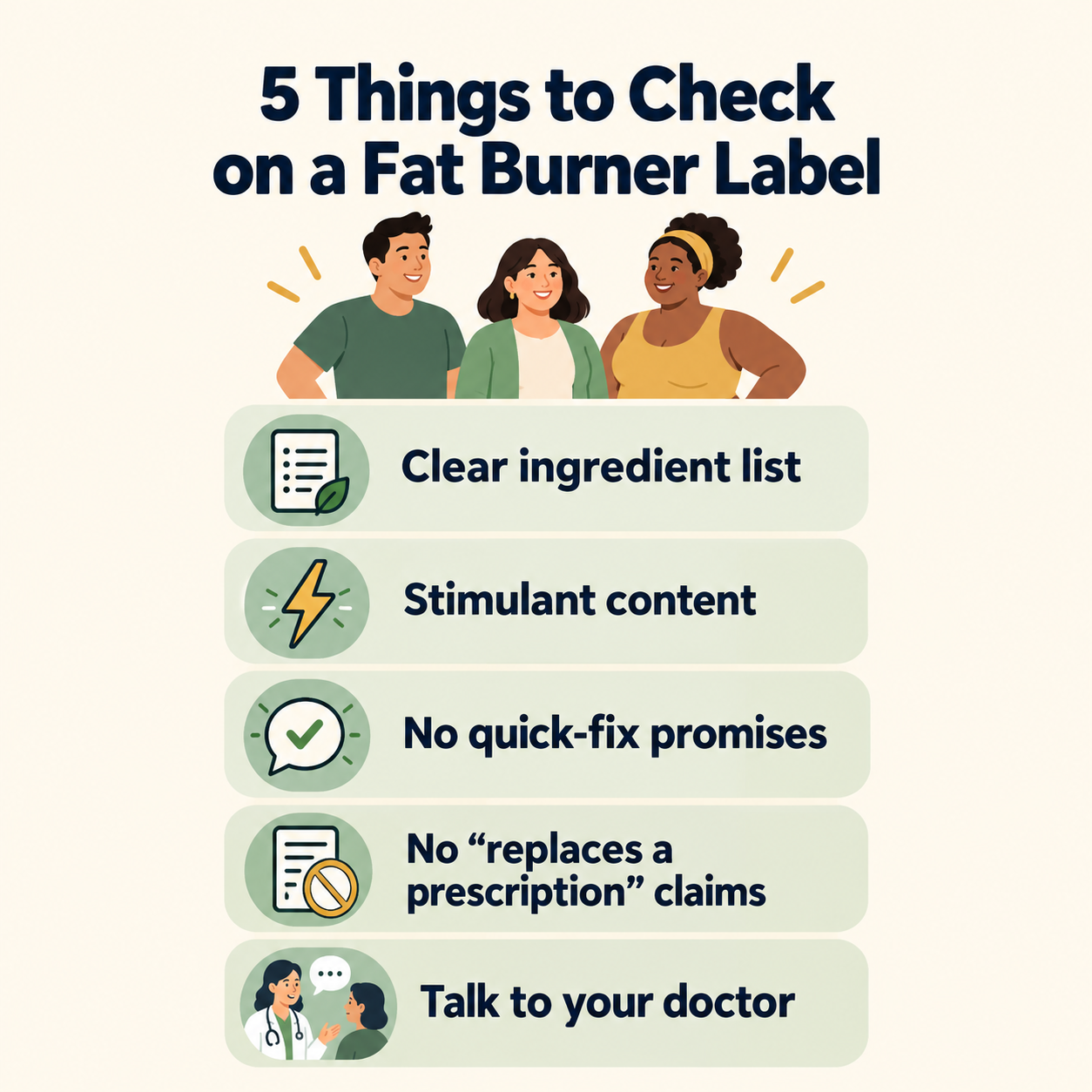
Whatever you are considering, run it through these checks:
Read the full ingredient list. You should be able to identify every ingredient, and the label should not hide behind a vague "proprietary blend" you cannot evaluate.
Check for stimulants. Caffeine, bitter orange, and similar ingredients can interact with medications and affect sleep, heart rate, and anxiety.
Notice the language. Quick-fix promises, "guaranteed," and "scientific breakthrough" are FDA-listed red flags.
Be wary of comparisons to prescriptions. A supplement is not a substitute for a prescription drug, and any product claiming the same effects deserves extra scrutiny.
Talk to your doctor. The NIH advises that weight-loss supplements can have harmful side effects and might interact with prescription and over-the-counter medications.
Frequently Asked Questions
What is the best natural fat burner?
No single natural fat burner has been proven best. The NIH reports limited evidence for weight-loss supplements overall. Look for a transparent ingredient list, avoid quick-fix claims, and pair any supplement with balanced nutrition and regular movement. Ask your doctor whether a given ingredient is appropriate for you.
Do natural fat burners really work?
Some individual ingredients show small effects in studies, but most results are modest, and evidence for finished multi-ingredient products is often limited. Supplements are best viewed as a possible supporting layer on top of healthy eating and physical activity, not a replacement for either.
Are natural fat burners safe?
Safety depends on the specific ingredients, the dose, and your health and medications. "Natural" does not guarantee safety. The FDA has found weight-loss products with undeclared drug ingredients, so buy from transparent sources and speak with your doctor before starting any new supplement.
Is GLP THREE a fat burner?
GLP THREE is a natural liquid supplement formulated to support the body's own GLP-1 pathway, appetite signaling, fat metabolism, and lean muscle maintenance as part of an active lifestyle. It is not a drug, does not contain semaglutide or synthetic hormones, and individual results vary.
Is a natural supplement the same as Ozempic?
No. Ozempic is an FDA-approved prescription injection containing semaglutide, a synthetic medication. GLP THREE is a dietary supplement taken by dropper, made with natural ingredients that support existing biology. It is not FDA-approved as a drug, and it should not be expected to produce the same effects.

Ready to Learn More?
If you are still weighing your options, start with the basics: a balanced plate, regular movement, and a conversation with your doctor. If a natural supplement that supports the body's own GLP-1 pathway sounds like a fit for your routine, you can learn more about GLP THREE and place an order here. The purchase includes a one-time free consultation and Body Composition Analysis with Dr. Chris Colgin.
These statements have not been evaluated by the Food and Drug Administration. This product is not intended to diagnose, treat, cure, or prevent any disease. Individual results may vary. Talk to your doctor before starting any new supplement.