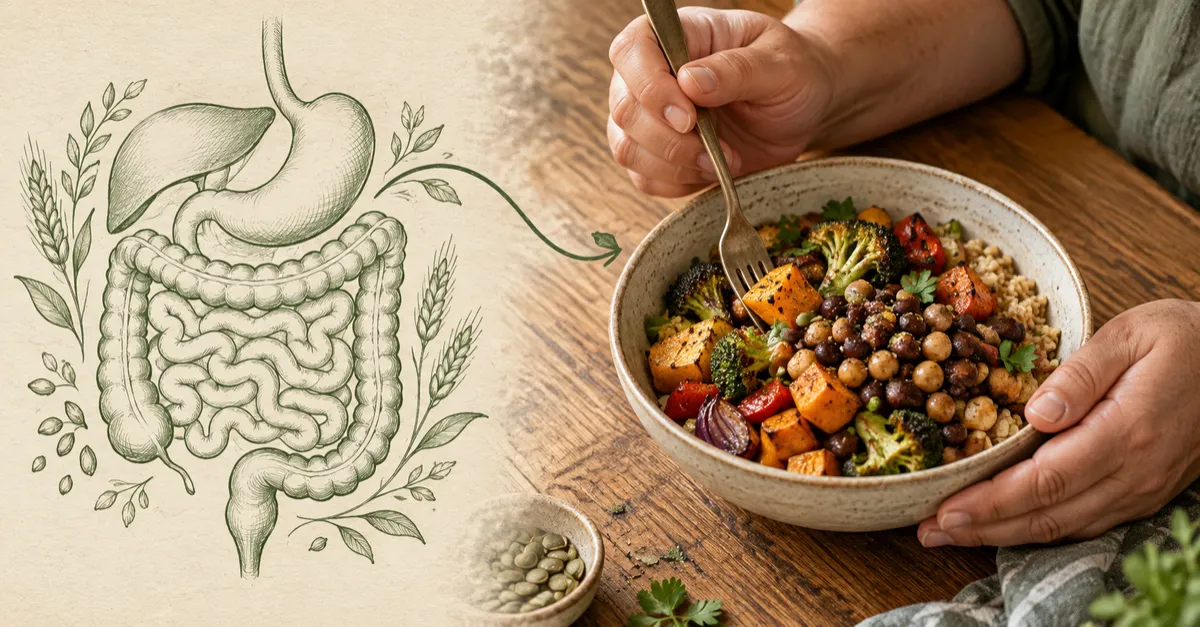
Gut Health for Weight Loss: What the Research Says
If you have searched for ways to manage your weight lately, you have probably run into the same idea more than once: fix your gut, and your appetite and weight will follow. It is a reasonable question, and it rests on real science. It is also an idea that gets oversold quickly.
This guide walks through what researchers have found about gut bacteria, dietary fiber, and the hormones that signal fullness, including where the evidence is solid and where it is still thin. It is published on glpthreelife.com, the national affiliate site for GLP THREE, so you should know up front that we sell a supplement. We have held this article to a simple standard: no invented numbers and no promises.
Quick Answer: Gut health may influence weight through appetite signaling. Gut bacteria ferment dietary fiber into short-chain fatty acids, which laboratory research links to the release of fullness hormones such as GLP-1. However, human evidence that changing gut bacteria causes weight loss is still limited, so a fiber-rich, varied diet is a reasonable place to start.
Key Takeaways
Gut bacteria ferment fiber into short-chain fatty acids, and laboratory studies link those compounds to the release of GLP-1, a hormone involved in fullness signaling.
Most U.S. adults fall short on fiber, averaging roughly 16 grams per day against a recommended 22 to 34 grams depending on age and sex.
Human evidence that gut bacteria directly cause or reverse weight gain is still limited, and probiotic trials show modest or inconsistent results.
Diet can shift gut bacteria within days, which makes consistent food choices the most practical lever you control.
Gut health is one input into appetite regulation, not the whole story.
How Does Your Gut Influence Appetite and Fullness?
What does "gut health" actually mean?
Your digestive tract hosts trillions of microorganisms, collectively called the gut microbiome. "Gut health" does not have a single clinical definition. In everyday use, it describes a varied, well-fed community of gut bacteria along with comfortable, regular digestion. It is a useful shorthand, but it is not a diagnosis or a measurable score you can check at home.
How do gut bacteria connect to fullness signals?
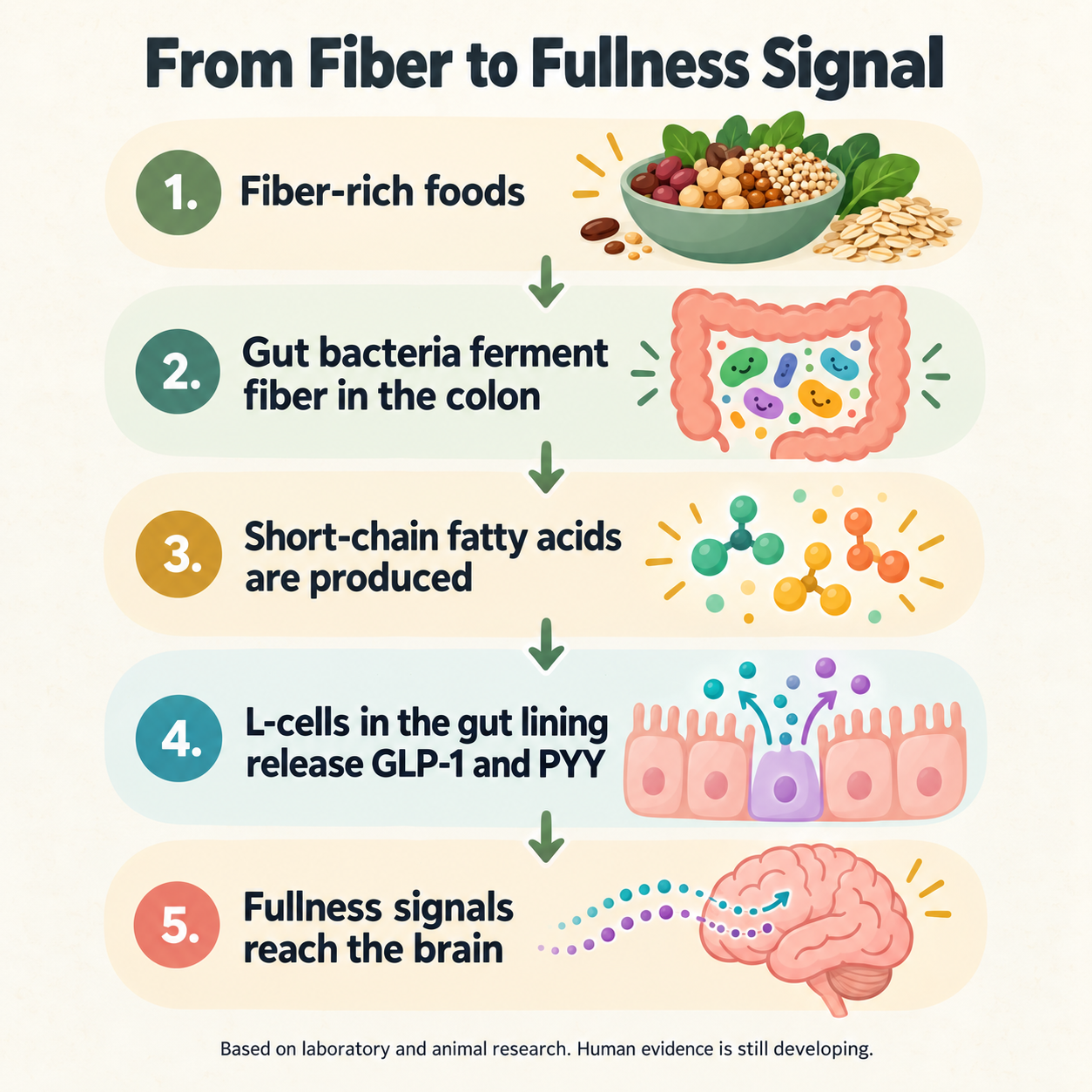
Here is the part of the science that gets the most attention. When you eat fiber your body cannot digest on its own, it travels to the colon, where bacteria ferment it. One result is a group of compounds called short-chain fatty acids, including acetate, propionate, and butyrate.
In laboratory research, these compounds bind to receptors on specialized intestinal cells called L-cells, and those cells release gut hormones. Reviews describe how short-chain fatty acids prompt release of both GLP-1 and PYY, which then signal the brain through the vagus nerve or the bloodstream. GLP-1 is a hormone your body already makes. It is released after eating and is part of how your body signals fullness.
There is an important caveat. Much of this work comes from cell cultures and animal models, and a recent narrative review notes that these gut microbiota interactions are supported primarily by preclinical studies and associative human data. The pathway is real biology. How much it matters for weight in any one person is a separate question.
Does Improving Gut Health Actually Lead to Weight Loss?
This is where honesty matters most. Gut bacteria and body weight are clearly associated in many studies. That is not the same as proving one drives the other.
A review in Science Translational Medicine concluded that while rodent studies suggest a link, human evidence for a causal role of the gut microbiome in obesity remains scarce. A review in Gastroenterology made a similar point, noting that with a few exceptions, most publications report associations between gut microbial composition and metabolic outcomes rather than proven cause and effect.
Do probiotics help with weight loss?
Probiotics are the most common way people try to act on the gut-weight connection, and the results are mixed. A critical review of randomized trials describes an umbrella meta-analysis of 29 meta-analyses covering 14,366 adults, which found an average body weight reduction of about 0.38 kg that the authors described as statistically significant but clinically modest.
A more recent meta-analysis of randomized trials in adults with overweight or obesity found that body weight was not significantly affected by probiotics or synbiotics. Strain, dose, trial length, and the diet people eat alongside the product all vary from study to study, which makes it hard to draw one clean conclusion.
What is the honest bottom line?
The gut matters, and the biology connecting it to appetite signaling is genuine. But it is not a single lever you can pull in isolation. The most defensible reading of the research is that gut-supportive eating is a sensible part of an overall approach, not a standalone solution.
What Does a Gut-Supportive Way of Eating Look Like?
How much fiber do you need?
The Dietary Guidelines for Americans recommend roughly 22 to 34 grams of fiber per day, depending on age and sex, or about 14 grams for every 1,000 calories you eat. Most adults eat less than half of that. Harvard Health points to refined grains stripped of fiber and ready-to-eat processed foods as major reasons why.
How can you add fiber without discomfort?
Adding a lot of fiber all at once can cause bloating and cramping. A registered dietitian at Cleveland Clinic suggests adding no more than 5 grams of fiber per week until you reach your goal. A gradual approach might look like this:
Add one fiber-rich food at a time, such as lentils or beans in a meal you already eat.
Swap refined grains for whole grains where it feels easy.
Include fruit or vegetables at most meals.
Add a small serving of nuts or seeds each day.
Harvard Health lists fruits, vegetables, whole grains, legumes, nuts, and seeds as the main sources. If you have a digestive condition or take medication, talk with your doctor before making large changes.
How quickly does your gut respond to what you eat?
Faster than most people expect. In a well-known study, researchers placed 10 volunteers on a plant-based diet and an animal-based diet in turn, and found that gut bacteria shifted within days. The study was small, the diets were extreme, and it was not a weight loss trial. Still, it supports a practical point: the food you eat this week is shaping the gut environment you have this week.
Why Can Weight Management Feel Harder Than Food Choices Alone?
Many people who research gut health have already tried to eat better. If that is you, and your appetite still seems to work against you, that experience has a biological layer. Hunger and fullness are physiological signals, not simply a test of willpower. The gut releases hormones such as GLP-1 and PYY that travel to the brain to help regulate appetite.
Gut bacteria are one input into that system, alongside genetics, sleep, stress, activity, and the food on your plate. No single input explains everything, and no single habit fixes everything. That is why this article does not promise that a probiotic or a high-fiber week will change your weight. It is also why a steady, realistic pattern is a more sensible goal than a dramatic reset.

Where Does GLP THREE Fit Into This Picture?
Food and gut habits are the foundation. A supplement is not a substitute for them. With that said, here is what GLP THREE is, so you can decide whether it is relevant to you.
GLP THREE is a natural liquid dropper supplement. It is not a prescription medication, it requires no prescription, and it involves no injections. It is not a probiotic, prebiotic, or fiber product, and it does not contain semaglutide or any synthetic hormone.
It contains a patented MBC-267 peptide complex (derived from salmon in the Norwegian Sea and select mushrooms) plus Panax Ginseng Extract, Saffron Extract, and Humulus Lupulus (Hops) Extract. It is formulated to support the body's own GLP-1 pathway, appetite signaling, fat metabolism, and lean muscle maintenance as part of an active lifestyle. The product was formulated by Dr. Dan Gubler, a Caltech-trained PhD organic chemist.
A 4-bottle supply costs $289 and includes a one-time free consultation and a computerized Body Composition Analysis with Dr. Chris Colgin, DC, a licensed chiropractic physician who has practiced since 1996 and serves as Director of Optimal Health Members. That consultation is a one-time benefit of the purchase. GLP THREE does not include ongoing lab monitoring, physician-adjusted dosing, or a supervised clinical program.
As with any supplement, talk to your doctor before you start.
Frequently Asked Questions
Can improving gut health help you lose weight?
Possibly as one supporting factor, but the evidence is not conclusive. Gut bacteria produce compounds linked to fullness hormones in laboratory research, yet reviews note that human proof of a direct cause-and-effect link to weight is limited. Fiber-rich eating and overall lifestyle habits are the more reliable places to focus.
How long does it take to change your gut bacteria with diet?
In one small controlled study of 10 adults, gut bacteria shifted within days of a major diet change. That does not mean lasting change happens that fast. Steady, repeated food choices over weeks are a more realistic approach than a short reset, and individual results vary.
Do probiotics help with weight loss?
Results are mixed. One umbrella analysis found an average reduction of about 0.38 kg, described as statistically significant but clinically modest, while a more recent meta-analysis in adults with overweight or obesity found no significant change in body weight. Strain, dose, and study design all affect outcomes.
What foods are best for gut health and weight management?
Fiber-rich whole foods are the most consistently recommended starting point: vegetables, fruit, legumes, whole grains, nuts, and seeds. Harvard Health notes that refined grains and ready-to-eat processed foods contribute to low fiber intake. Add new fiber gradually, about 5 grams per week, to limit bloating.
Is GLP THREE a gut health supplement?
No. GLP THREE is a natural liquid dropper supplement formulated to support the body's own GLP-1 pathway and appetite signaling. It is not a probiotic or fiber product, contains no synthetic hormones, and is not a prescription medication. Talk to your doctor before starting any new supplement.

If this article raised more questions than it answered, that is a reasonable place to be. The research on gut health and weight is promising and unfinished, and the most practical steps (more fiber, added gradually, from a variety of whole foods) are available to you today.
If you would like to learn more about GLP THREE, you can review product details and ordering information on the GLP THREE order page.
These statements have not been evaluated by the Food and Drug Administration. This product is not intended to diagnose, treat, cure, or prevent any disease. Individual results may vary. Talk to your doctor before starting any new supplement.