
Non-Prescription Weight Loss: What Actually Works
You have probably already done the math. Prescription GLP-1 medications are everywhere in the news, but they require a prescriber, often a fight with insurance, and a weekly injection. So the question becomes simple and very reasonable: what can you actually do without a prescription, and does any of it work?
In 30 years of clinical practice, this is one of the questions I hear most often. The honest answer is that non-prescription weight loss works best as a system, not a single product. The habits that move the needle are well studied. Supplements can play a supporting role. And the most important skill you can develop is learning to tell the difference between a plan built on evidence and a product built on hype.
Quick Answer: Non-prescription weight loss means supporting a healthier weight without a prescription drug. The approaches with the strongest evidence are adequate protein, regular movement including strength work, consistent sleep, and gradual habit change. Natural dietary supplements can support these efforts, but they are not FDA-approved drugs and should complement, not replace, the fundamentals.
Key Takeaways
Even modest weight loss of about 5% can improve blood pressure, cholesterol, and blood sugar levels, according to the CDC's guidance on losing weight.
People who lose weight gradually, about 1 to 2 pounds per week, are more likely to keep it off, per the same CDC guidance.
Short sleep raised the hunger hormone ghrelin by 28% and lowered the fullness hormone leptin by 18% in a controlled study published in the Annals of Internal Medicine.
The FDA does not approve dietary supplements before they are sold, so manufacturers are responsible for safety and for backing up their claims, as explained in the FDA's dietary supplement Q&A.
The FDA maintains an ongoing list of weight loss products sold as supplements that were found to contain hidden drug ingredients, which makes label literacy a real safety skill.
What Counts as Non-Prescription Weight Loss?
Non-prescription weight loss is any approach to a healthier weight that does not require a doctor to write you a prescription. That covers a wide range:
Lifestyle changes: how you eat, how you move, how you sleep, and how you manage stress.
Structured programs: commercial or community weight management programs.
Dietary supplements: products sold directly to consumers, regulated as a category of food rather than as drugs.
What it does not include is prescription GLP-1 receptor agonists such as semaglutide (Ozempic, Wegovy) or tirzepatide (Zepbound, Mounjaro). Those are FDA-approved drugs that require a prescriber's evaluation and ongoing medical management.
That distinction matters because it changes what you should expect. A prescription drug has passed clinical trials for a specific use. A supplement has not gone through that approval process. The FDA states plainly that it does not have the authority to approve dietary supplements before they are marketed, and that a product represented as treating or curing a disease is legally a drug, not a supplement. Any supplement that promises drug-level results should raise your guard, not your hopes.
Why Is Weight So Hard to Manage Without Medication?
If you have tried and struggled, it was not simply a willpower problem. Your body regulates weight through a network of hormones and signals that respond to how you eat, sleep, and move.
One of those signals is GLP-1, a hormone your gut produces naturally after meals. A review of GLP-1 physiology in Physiological Reviews describes its main roles: it helps stimulate insulin release, slows how quickly food moves through the stomach, and appears to act as a natural regulator of appetite and food intake. Prescription GLP-1 drugs are synthetic versions designed to act on that same receptor at pharmacological doses.
Other signals pull in the opposite direction. In a randomized crossover study from the University of Chicago, just two nights of restricted sleep lowered leptin, raised ghrelin, and increased hunger by 24%, with the strongest cravings for calorie-dense, high-carbohydrate foods. The study was small (12 healthy young men), but the finding is one I see reflected in practice constantly: when sleep slips, appetite gets louder.
This is the core reason non-prescription weight loss has to be layered. You are not fighting one thing. You are working with an entire signaling system.
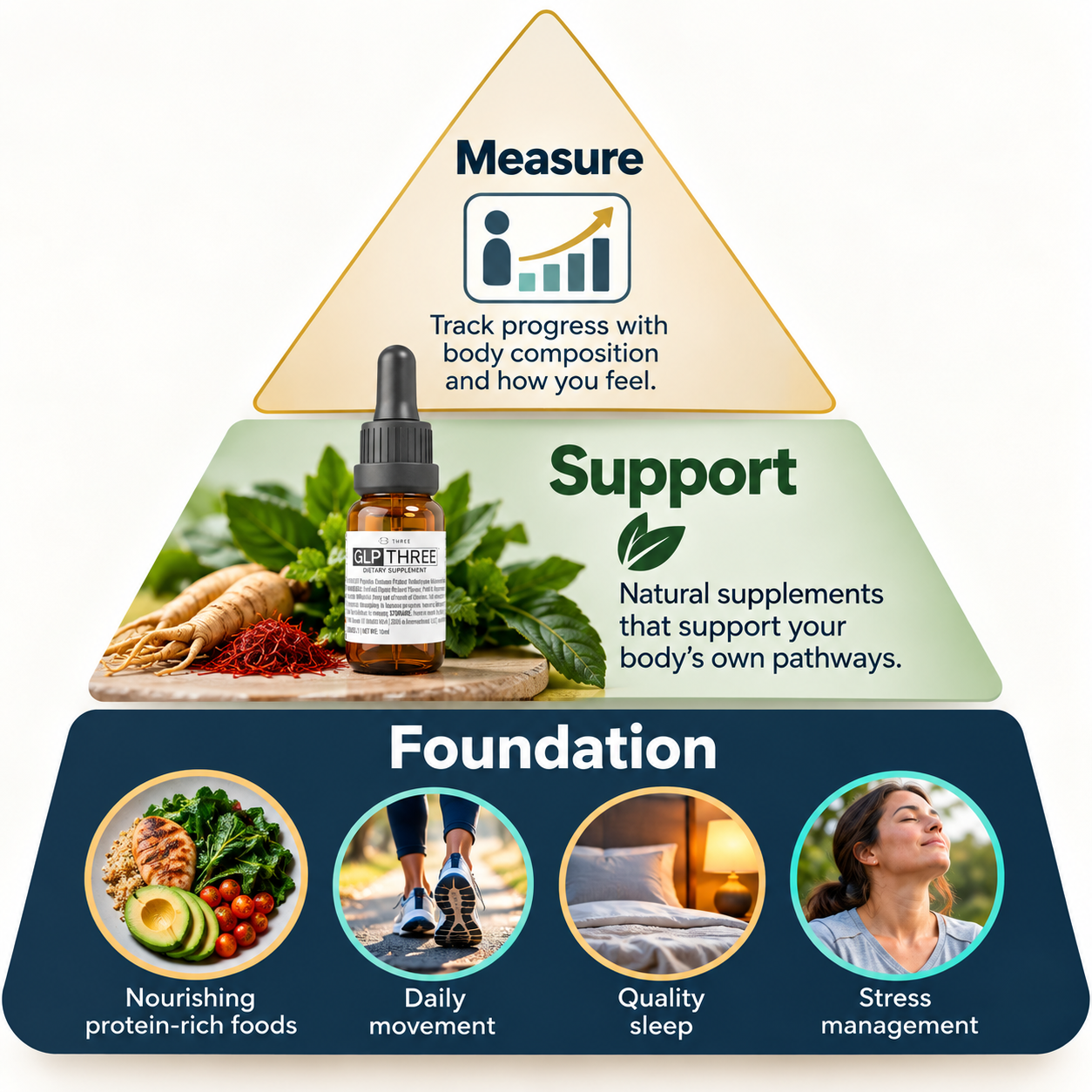
The Foundation, Support, Measure Framework
When patients ask me where to start, I walk them through three layers, in this order. The order matters more than people expect.
Layer 1: Foundation (the habits with the strongest evidence)
These are the levers that research supports most consistently, and they cost little or nothing.
Protein at every meal. A review in the American Journal of Clinical Nutrition found that higher-protein diets during calorie reduction were associated with greater fat loss and better preservation of lean mass, along with a modest increase in feelings of fullness. The authors point to roughly 25 to 30 grams of protein per meal as a practical target. They also note that results depended heavily on whether people actually stuck with the plan, which is a recurring theme.
Strength work, not just cardio. When you lose weight, you want to lose fat, not muscle. Lean muscle supports your metabolism and your ability to stay active as you age. Two or three sessions a week of resistance training, even bodyweight exercises at home, is a reasonable starting point for most adults cleared for exercise.
Sleep as a non-negotiable. Given the hormone shifts described above, consistent sleep is one of the most underrated tools in weight management. The CDC lists enough sleep alongside nutrition, physical activity, and stress management as core parts of a healthy weight lifestyle.
Gradual, realistic goals. Aim for about 1 to 2 pounds a week, and remember that a 5% change is meaningful. For someone at 200 pounds, that is 10 pounds.
Layer 2: Support (where supplements fit, and where they do not)
Once the foundation is in place, some people look for additional support with appetite and metabolism. This is where natural dietary supplements come in, and where you need to be the most careful.
A responsible supplement should support the systems your body already uses. It should not claim to replace a medication, and it should never claim to treat a disease. Some individual botanical ingredients have been studied for appetite-related outcomes. For example, an 8-week randomized, placebo-controlled study of a saffron extract in 60 mildly overweight women reported reduced snacking frequency and greater satiety compared with placebo. That is a study of one ingredient in one population, not proof that any finished product works the same way, and it should be read that way.
Layer 3: Measure (tracking what actually changes)
The bathroom scale tells you one number. It does not tell you whether you lost fat or muscle, or whether your body composition is moving in the right direction. Tracking how your clothes fit, your energy, your strength, and, when available, a body composition analysis gives you a far more useful picture.
How Do You Know if a Non-Prescription Weight Loss Supplement Is Legitimate?
This is the section I most want you to take with you, because the stakes are real. The FDA keeps a running list of weight loss products marketed as supplements, teas, or "all-natural" treatments that were found to contain hidden drug ingredients. The agency warns that these products often have many positive reviews and spread through social media, and that a product's absence from the list does not mean it is safe.
Before you buy any supplement, run it through these checks:
Read the Supplement Facts panel. Every ingredient should be listed. The FDA requires a Supplement Facts panel, a list of other ingredients, and contact information for reporting adverse events.
Watch the language. Claims like "melts fat," "cures obesity," or "works just like Ozempic" are red flags. Legitimate supplements use structure/function language, such as "supports healthy weight management."
Look for the disclaimer. Supplements making structure/function claims are required by law to state that the FDA has not evaluated those claims. If a product skips it, ask why.
Check for real people behind it. Who formulated the product? Who stands behind it? Credentials should be specific and verifiable.
Talk to your doctor first. The FDA advises consumers to check with a health care professional before starting any supplement, since some can interact with medications.

What Happens When People Stop Prescription GLP-1 Drugs?
Many readers looking into non-prescription weight loss are not starting from scratch. Some are considering coming off a prescription GLP-1 medication, or have already stopped because of cost, side effects, or access.
Here is what the research shows, stated plainly. In the STEP 1 trial extension, adults who had taken semaglutide 2.4 mg for 68 weeks lost an average of 17.3% of their body weight. One year after stopping the medication and the trial's lifestyle program, they had regained about two-thirds of that loss, and most cardiometabolic improvements drifted back toward baseline. The researchers concluded that ongoing treatment appears necessary to maintain the results.
That is not an argument for or against the medication. It is a reminder that the drug does not build the habits for you. If you are stepping off a prescription, that transition should be planned with the prescribing physician, and the Foundation layer becomes even more important. A supplement is not a substitute for that medication, and it is not designed to produce the same results.
Where Does GLP THREE Fit in a Non-Prescription Approach?
GLP THREE is a natural liquid dropper supplement. It is not a prescription medication, it is not a clinical program, and it does not contain semaglutide or any synthetic hormone.
It was formulated by Dr. Dan Gubler, a Caltech-trained PhD organic chemist, and contains a patented MBC-267 peptide complex (derived from salmon from the Norwegian Sea and select mushrooms), along with Panax Ginseng Extract, Saffron Extract, and Humulus Lupulus (Hops) Extract. It is designed to support the body's own GLP-1 pathway, healthy appetite signaling, blood sugar levels already in a normal range, fat metabolism, and lean muscle maintenance as part of an active lifestyle.
Here is how it compares to prescription GLP-1 medications on the facts that matter:
GLP THREE | Prescription GLP-1 drugs | |
|---|---|---|
What it is | Natural dietary supplement | FDA-approved prescription drug |
Mechanism | Natural ingredients that support existing biology | Synthetic hormone that activates the GLP-1 receptor |
How it is taken | Liquid dropper | Injection (most forms) |
Prescription needed | No | Yes |
Medical oversight built in | No; talk to your own doctor | Yes, through the prescriber |
In the Foundation, Support, Measure framework, GLP THREE belongs in the Support layer. It is meant to work alongside protein, movement, and sleep, not instead of them.
A 4-bottle supply is $289 and includes a one-time free consultation and a computerized Body Composition Analysis with me. That analysis is a useful starting point for the Measure layer, since it shows more than a bathroom scale can. To be clear about what it is not: there is no ongoing lab monitoring, physician-adjusted dosing, or bloodwork-based program included with the product. Your own physician remains your partner for medical decisions.

Frequently Asked Questions
What is the most effective non-prescription weight loss approach? The approaches with the strongest research support are eating adequate protein, doing regular physical activity that includes strength training, getting consistent sleep, and losing weight gradually. These fundamentals affect the hunger and fullness signals that drive eating. Supplements can play a supporting role, but they work best layered on top of these habits.
Can you lose weight without a prescription? Yes. Many people reach a healthier weight through lifestyle changes alone, and even a 5% reduction can improve blood pressure, cholesterol, and blood sugar levels, according to the CDC. A gradual pace of about 1 to 2 pounds per week is associated with better long-term maintenance than rapid weight loss.
Are non-prescription weight loss supplements FDA approved? No. The FDA does not approve dietary supplements before they are sold. Manufacturers are responsible for ensuring safety and for having evidence that their claims are truthful. That is why reading labels, checking for the required FDA disclaimer, and talking with your doctor before starting a supplement are important steps.
Is a natural supplement the same as Ozempic? No. Ozempic is an FDA-approved prescription drug containing semaglutide, a synthetic hormone given by injection. A natural supplement like GLP THREE uses different ingredients, a different mechanism, and a different delivery method. It is designed to support the body's own GLP-1 pathway and is not intended to produce the same results.
How do I spot an unsafe weight loss supplement? Be cautious of products promising rapid results, claiming to cure obesity, or saying they work just like a prescription drug. Check for a complete Supplement Facts panel and the required FDA disclaimer. The FDA keeps a public list of weight loss products found to contain hidden drug ingredients, which is worth searching before you buy.
These statements have not been evaluated by the Food and Drug Administration. This product is not intended to diagnose, treat, cure, or prevent any disease. Individual results may vary. Talk to your doctor before starting any new supplement.
Your Next Step
You came here asking whether non-prescription weight loss actually works. It does, when you treat it as a system rather than a shortcut. Build the foundation first. Add support thoughtfully. Measure what really changes. And be skeptical of anything that promises to skip the first step.
If you are ready to add the Support and Measure layers, you can explore GLP THREE and its ingredients here. Every 4-bottle supply includes a free consultation and Body Composition Analysis, so you start with a clear picture of where you are.
The goal was never just a smaller number. It is a body you can live well in, for the long haul.